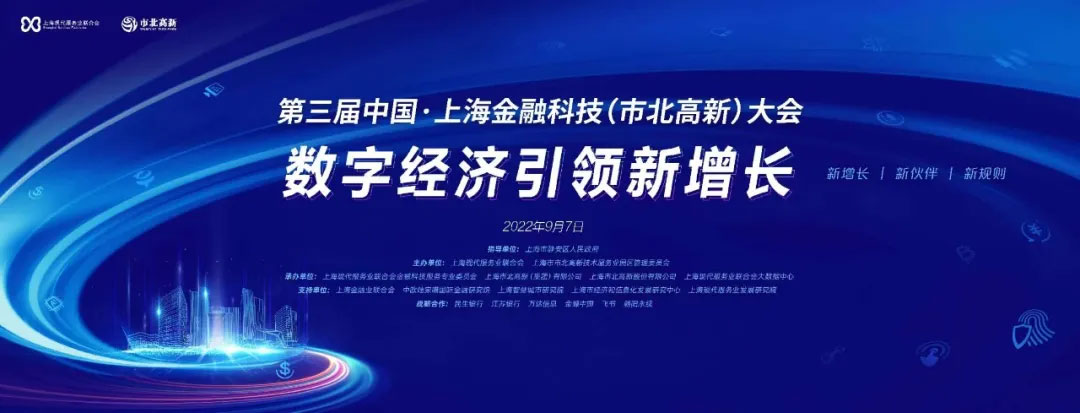
On September 7, 2022, the "3rd China·Shanghai Fintech (Shibei Hi-Tech) Conference" with the theme "Digital Economy Leading New Growth" was grandly held at the Shibei Hi-Tech Business Center in Jing'an District.
Guided by the People's Government of Jing'an District, Shanghai, the conference was hosted by the Shanghai Modern Service Industry Federation and the Administrative Committee of Shanghai Shibei High-Tech Service Industry Park. It was organized by the Fintech Service Professional Committee of Shanghai Modern Service Industry Federation, Shanghai Shibei Hi-Tech (Group) Co., Ltd., Shanghai Shibei Hi-Tech Co., Ltd., and the Big Data Center of Shanghai Modern Service Industry Federation. Supporting organizations included the Shanghai Financial Industry Federation, China-Europe Lujiazui International Finance Research Institute, Shanghai Smart City Development Research Institute, Shanghai Modern Service Industry Development Research Institute, Shanghai Economic and Information Technology Development Research Center, etc. Strategic cooperation partners included Minsheng Bank, Shanghai Branch of Jiangsu Bank, Wanda Information, Kingdee China, Lark, and Chaoyang Yongxu.
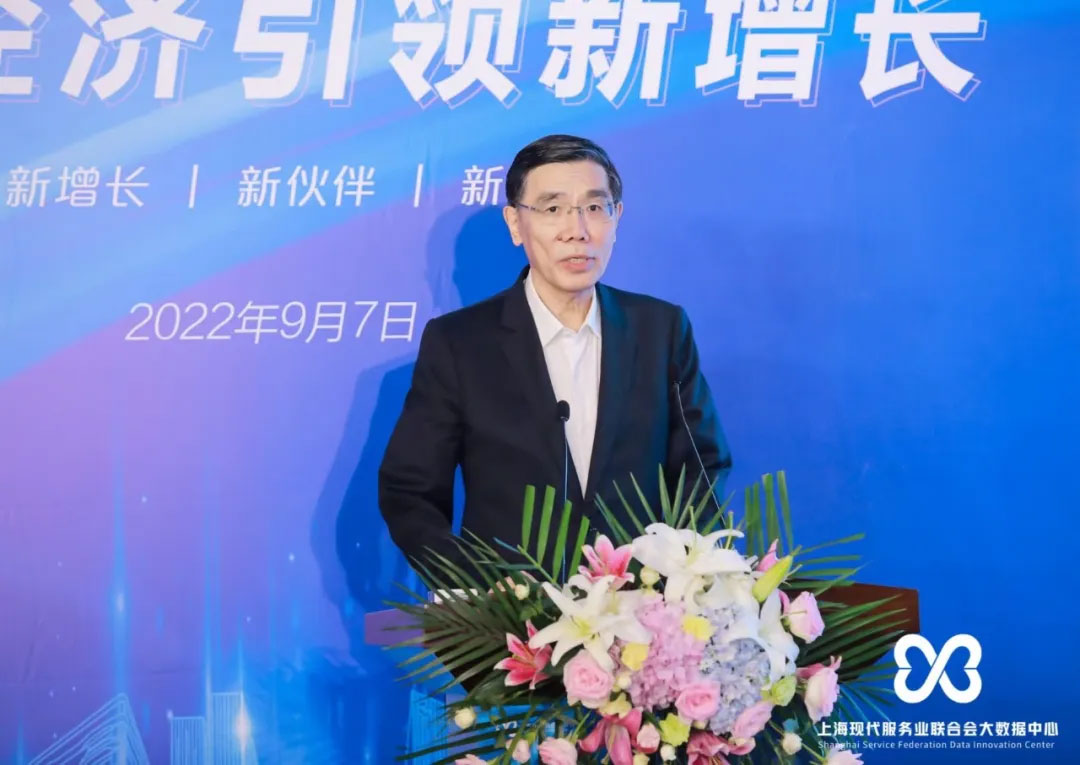
Fintech Has Entered Era 4.0
Jiang Jianqing began by analyzing the profound shifts in the global top 10 listed companies by market capitalization over the past four decades. Once-dominant banks and oil giants have fallen out of the rankings, while technology firms now take the lead. This trend is equally evident both internationally and domestically. In his view, the internet economy has been China’s most prominent economic pillar and the most wealth-generating sector over the past 20 years.
“The transformation in market capitalization essentially reflects the advancement of modern fintech,” Jiang noted. He then elaborated on the evolutionary stages of China’s fintech development, summarizing four key phases:
Fintech 1.0 (Pre-2000): This phase centered on the adoption of traditional software and hardware to digitize and automate office operations and business processes, thereby enhancing the operational efficiency of the financial industry.
Fintech 2.0 (2000-2010): Driven by the escalating management demands of China’s financial sector, this period witnessed large-scale data centralization. It substantially elevated financial institutions’ capabilities in business innovation, internal management, risk control, and customer service. While banks maintained distinct competitive advantages during this stage, the balance of power had already begun to tilt toward fintech companies.
Fintech 3.0 (2010 onwards): The banking industry achieved rapid fintech progress but faced intense competition from non-bank financial entities, losing its competitive edge and market position in the small-ticket business segment. This era was characterized by drastic changes and rampant irregularities. However, a series of coordinated regulatory measures implemented by the central bank and supervisory authorities rectified the chaotic competition in the fintech space. “Although fintech improved the operational efficiency of the financial industry during this phase, it did not alter its inherent logic and mechanisms,” Jiang emphasized.
Fintech 4.0 (Present): After decades of development, fintech has entered the digital era, with digital transformation experiencing explosive growth. In 2021, China’s digital economy reached 45.5 trillion yuan, accounting for 39.8% of GDP. The global COVID-19 pandemic further accelerated the development of the global digital economy: enterprises seized the opportunity to enhance their digital management and operational capabilities, leveraging technological empowerment to achieve remarkable business results. Local governments also expedited the implementation of digital government governance, leading to the rapid emergence of smart cities, smart hospitals, smart schools, and smart government platforms.
Thus, Jiang concluded that in the era of Fintech 4.0, developing fintech should be the core strategy for the future development of most Chinese financial institutions.
Building Shanghai’s International Financial Center Requires Fintech
Jiang proposed that the construction of Shanghai’s international financial center is inseparable from fintech, highlighting four key focus areas:
1. Align with Shanghai’s Urban Digital Transformation: In accordance with Shanghai’s overall plan for advancing urban digitalization, it is imperative to transform traditional development models, address shortcomings, improve the governance capacity of the digital economy, and pursue a path of high-quality development. Currently, driven by next-generation technologies such as big data, cloud computing, blockchain, and artificial intelligence, the digital transformation of financial institutions is in full swing, with fintech providing revolutionary impetus for scenario empowerment.
2. Focus on Asset Conversion Capabilities: Banks’ core strength lies in asset conversion, including various credit guarantee businesses. The successful transformation of deposits into loans is crucial for the survival of financial institutions. “The asset conversion process is inherently a risk management process. To achieve safe asset conversion, it is necessary to identify risks, ensure risk affordability, and align risks with returns,” Jiang explained.
3. Prioritize Wealth Management: Asset management is one of the largest and fastest-growing segments in the global financial industry. In Shanghai, residents are increasingly benefiting from national economic development: measured by personal financial assets, Shanghai has become the world’s second-largest wealth management market. Although Shanghai’s asset management sector started late, it has developed rapidly, demonstrating strong resilience in asset growth and a positive long-term outlook. “A late start means an opportunity to learn from mature international experiences, adapt them to China’s national conditions, and establish more suitable systems and methodologies in a shorter timeframe,” Jiang added.
4. Strengthen Data Governance: It is projected that by 2025, China’s total data volume will rank first globally, accounting for over 27% of the world’s total. Data has become a key driver of China’s economic growth, and future successful enterprises will be those with exceptional data analysis and interpretation capabilities. “To unlock data value, enhance data governance and application capabilities, and establish corresponding data assets, Shanghai needs to strive to improve data ownership systems and protect privacy,” Jiang stressed.
In his concluding remarks, Jiang summarized that fintech development is a long-term challenge. While people celebrate today’s fintech achievements, newer and more unpredictable technological innovations will emerge in the future. It is foreseeable that the cycle of change will continue to shorten, repeatedly disrupting existing financial models and posing profound challenges to the industry. “In the new fintech cycle, both traditional financial institutions and fintech enterprises are moving toward the same goal from different paths. The ultimate winners will be those financial service providers that can maximize customer value, achieve digital transformation, and above all, exercise real-time risk control,” Jiang concluded.