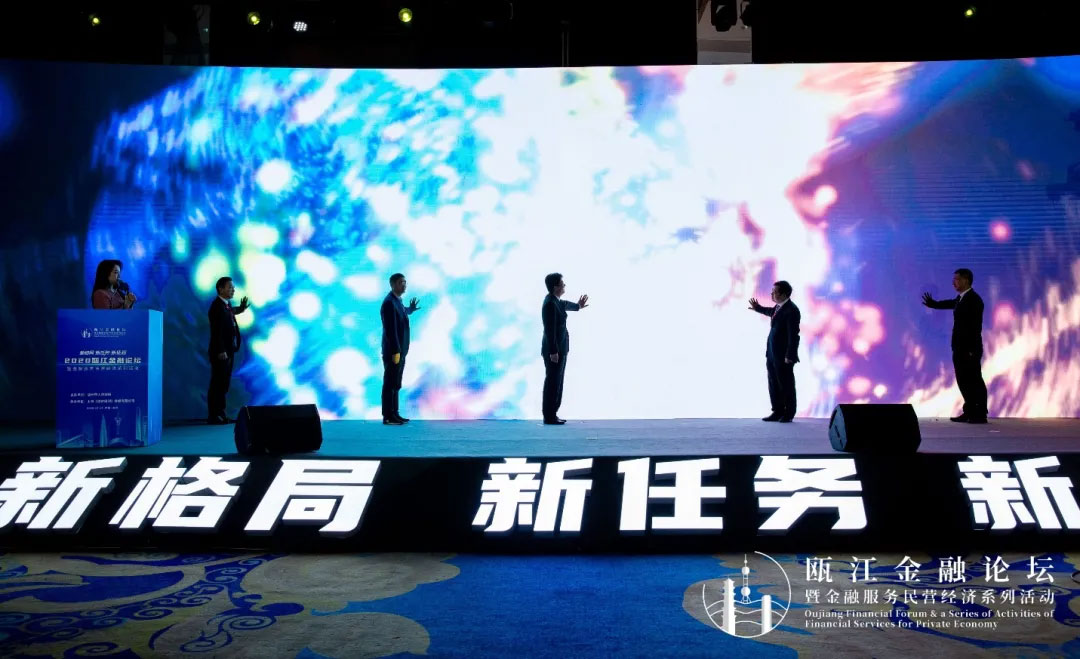
On the afternoon of December 18, the 2020 Oujiang River Financial Forum was solemnly held in the first-floor conference hall of Shangri?La Hotel, Wenzhou. Hosted by the Wenzhou Municipal People’s Government, this edition of the Oujiang River Financial Forum stands as one of the highest?profile financial forums in Wenzhou’s history, serving as the centerpiece of the series of events focused on financial services for the private economy. Under the theme “New Landscape, New Mandate, New Journey”, the forum brought together a number of highly influential distinguished guests from China’s financial sector, who delivered incisive and forward?looking insights. In addition to keynote speeches, a series of roundtable sessions also featured rich and stimulating discussions.
Hot Discussion on How Financial Reform Boosts the Transformation and Development of Private Enterprises
The theme of the first roundtable forum was Deepening Financial Reform to Boost the Transformation and Development of Private Enterprises. Moderated by Li Yang, Chairman of the National Institution for Finance & Development, Former Vice President of the Chinese Academy of Social Sciences, and Former Member of the Monetary Policy Committee of the People’s Bank of China, five distinguished representatives from academia and the business sector shared their insights.
Mo Wangui, Deputy Director of the Financial Research Institute of the People’s Bank of China, stated that combining an effective financial market with a proactive government is crucial to establishing institutions and mechanisms that effectively support the private and micro-enterprise sectors. An effective financial market requires efficient matching between financial supply and demand, as well as the cultivation of sound financial demand. A proactive government needs to address information asymmetry and risk-taking by financial institutions.
Yao Yudong, Vice President and Chief Economist of Dacheng Fund Management Co., Ltd., and Former Director of the Financial Research Institute of the People’s Bank of China, noted that Wenzhou’s financial reform has generally achieved expected outcomes without stagnation, a remarkable achievement that reflects Wenzhou’s entrepreneurial spirit. He suggested that Wenzhou should seize opportunities brought by the registration-based IPO system and capital market reforms, adhere to the principle that housing is for living in rather than speculation, and strengthen talent attraction.
Lian Ping, Chairman of the China Chief Economist Forum, Chief Economist of Cixin Investment, and Former Chief Economist of Bank of Communications, pointed out that Wenzhou’s financial reform has contributed significantly to the country, yet the issue of supporting micro-, small- and medium-sized enterprises has not been fully resolved. He put forward several proposals: financial support should prioritize long-term effects over short-term gains; small and medium-sized commercial banks, alongside large banks, should be encouraged to support the private economy; the role of direct financing should be enhanced; policy-based finance should play a greater part; and integrated resources from fiscal, information and industrial policies should be utilized.
Hu Ruyin, Member of the Strategic Advisory Committee for National Manufacturing Power Construction and Former Chief Economist of the Shanghai Stock Exchange, emphasized that solutions to financial challenges lie beyond finance itself. He observed that while Wenzhou entrepreneurs are often compared to the Jews of China, the Jewish community has completed modernization and leads globally in education and science and technology innovation. He urged Wenzhou to invest more in education, scientific and technological innovation.
Gao Tianle, Chairman and President of Wenzhou 天正 Group, shared his personal experience and insights. Having deeply participated in and witnessed Wenzhou’s financial reform, his enterprise has strongly benefited from the reform’s positive impacts on Wenzhou’s business environment.
In conclusion, Li Yang stressed that Wenzhou’s future development should strengthen direct financing, properly balance the relationship between the real economy and finance, integrate an effective market with a proactive government, and receive strong guidance and support from the government.
In-depth Talks on Financial Support for Private Enterprises in the Yangtze River Delta Regional Integration
The second roundtable forum focused on Financial Support for Private Enterprises to Participate in the Yangtze River Delta Regional Integration. It explored how the financial sector can advance institutional innovation, improve service capabilities, and support private enterprises in integrating into the national strategy of Yangtze River Delta integration. It also discussed cooperation with domestic and international financial institutions based in Shanghai to build a new highland for financial services supporting the private economy in the Yangtze River Delta, stimulate vitality among Wenzhou’s private enterprises, gather capital from Wenzhou entrepreneurs at home and abroad, and form a uniquely competitive industrial structure and market system in Wenzhou. Six guests delivered in-depth views around the three key concepts: finance, private economy, and Yangtze River Delta integration.
Nan Cunhui, Member of the Standing Committee of the National Committee of the Chinese People’s Political Consultative Conference, Vice Chairman of the All-China Federation of Industry and Commerce, and Chairman of Chint Group, is a renowned entrepreneur from Wenzhou with an early presence across the Yangtze River Delta. He viewed the regional integration as a historic opportunity for Wenzhou’s innovation. If Wenzhou can fully utilize talent, technology, capital and other resources within the Yangtze River Delta platform, he believed it would achieve a major leap forward.
Wang Song, Vice Chairman and President of Guotai Junan Securities, introduced that Guotai Junan is adjusting its strategy and increasing resource input into the Yangtze River Delta to support private enterprises in growing through IPOs, mergers and acquisitions, and strategic cooperation. He noted that investment banks now provide comprehensive financial services beyond traditional IPO underwriting, including co-investment, industrial layout optimization, and wealth inheritance for entrepreneurs.
Chen Qiwei, Vice President of the Shanghai Private Equity Association, Director of the China Venture Capital Research Center, and Chairman of Shanghai Asia Business Development Group, highlighted the profound significance of Yangtze River Delta integration. He advised Wenzhou to align integration with its own strengths and attach importance to fintech, which features problem orientation, deep integration with the real economy, and compatibility with financial regulation.
Zhuo Fumin, Vice President of the China Association of Chief Financial Officers, Chairman of Yuanxing Capital, emphasized that Wenzhou should seize three major opportunities: the new inflection point in the capital market, the new highland of consumption and technology, and emerging market hotspots.
Huang Fan, Member of the Global Education Advisory Board at CFA Institute and Former General Manager of China Business at United Overseas Bank Private Bank, pointed out that financial support operates on two fronts. In traditional indirect financing, banks should provide loans within the affordability of private enterprises, and foreign banks can support the private sector via cross-border lending. In direct financing, banks should develop high-end client services and facilitate corporate direct financing through institutional investment.
In summary, Ma Hong, Former Deputy Director of the Shanghai Financial Service Office and Chairman of Zhongye Capital, stated that the new round of Yangtze River Delta integration is not only about integrated development but also about technological and financial innovation under the new landscape. Wenzhou’s entrepreneurs should leverage their advantages to achieve new development and breakthroughs.
The speeches by the guests greatly inspired the audience and received an enthusiastic response at the forum.